
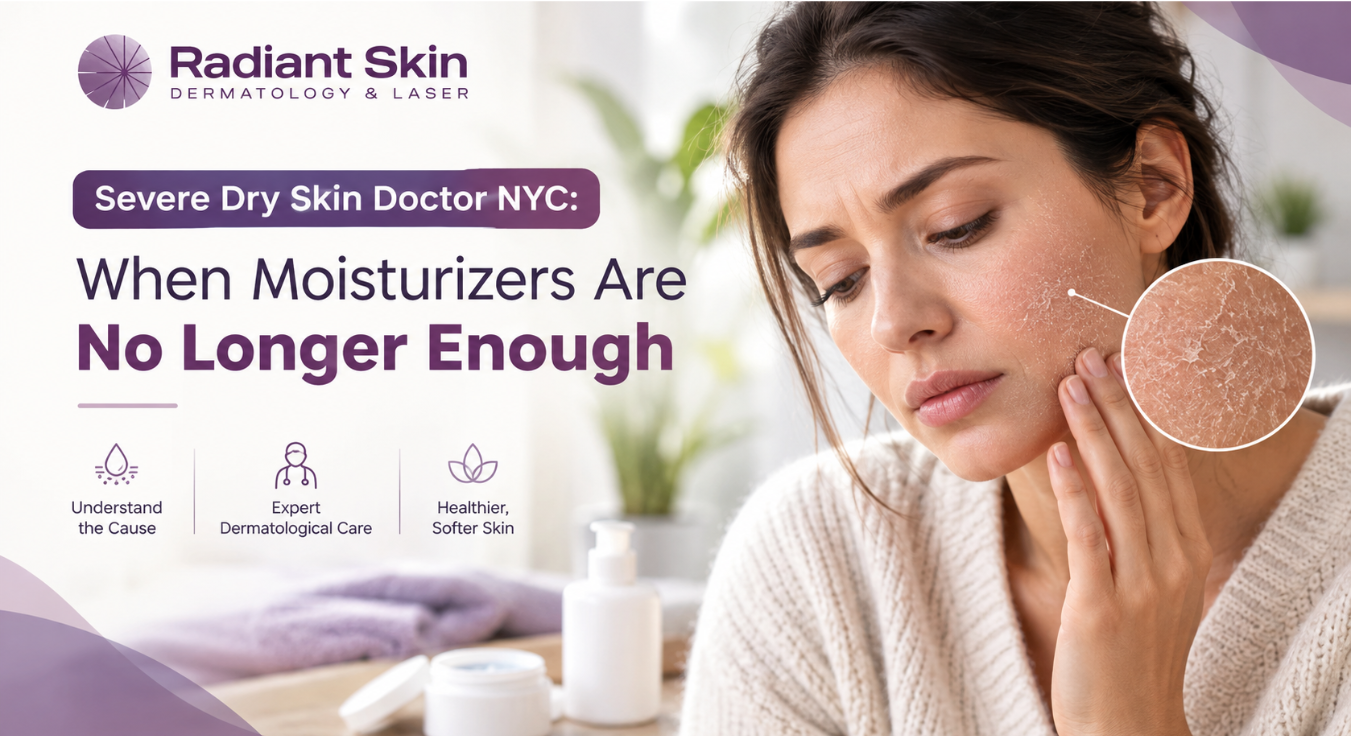
Dry skin can seem like a minor inconvenience until the tightness becomes constant, the itching keeps you awake, or small areas of flaking turn into painful cracks. At that point, simply adding another moisturizer to your routine may not address the real problem.
For people searching for a Severe Dry Skin Doctor NYC, the important question is not only how to make the skin feel softer. It is understanding why the skin is becoming so dry in the first place and whether an underlying dermatological condition needs attention.
At Radiant Skin NYC, skin concerns are approached with personalized dermatological care. The practice lists xerosis, or severely dryskin, alongside conditions such as atopic dermatitis and dermatitis.
Healthy skin helps retain moisture and provides a protective barrier against external irritants. When that barrier becomes compromised, water can escape more easily, leaving the skin rough, tight, flaky, or uncomfortable.
Occasional dryness may respond well to a consistent skincare routine. Persistent or severe symptoms, however, can point toward something that deserves professional evaluation.
· Persistent itching that keeps returning
· Flaking that does not improve with regular moisturizing
· Skin that feels unusually tight after bathing
· Roughor scaly patches
· Redness or irritation
· Cracks that become painful
· Thickened areas caused by repeated scratching
· Dryness affecting large areas of the body
· Symptoms that repeatedly improve and then flare again
Radiant Skin NYC identifies xerosis as severely dry skin, noting that it is common in older adults and during colder winter months.
Severe dryness does not always have one obvious explanation. Sometimes the environment is responsible; in other cases, the dryness may be connected to an inflammatory skin condition.
Cold weather, low humidity, indoor heating, and dry air can increase moisture loss and make already-sensitive skin feel considerably worse.
Long, hot showers can remove natural oils from the skin. Aggressive scrubbing can also irritate the skin barrier, particularly when dryness is already present.
Fragranced products, harsh cleansers, detergents, and certain personal-careing redients may aggravate sensitive or irritated skin.
Atopic dermatitis is a chronic, recurring skin disorder associated with dry, easily irritated, itchy skin. Radiant Skin NYC explains that managing the condition involves both daily skincare and appropriate treatment when flare-ups occur.
Dermatitis, commonly referred to as eczema, can produce itchy rashes that may become dry, discolored, and thickened when untreated or inadequately treated. Identifying the particular type of dermatitis is an important part of determining appropriate treatment.
This is why persistent dryness deserves more attention than simply asking,“Which moisturizer should I buy?”
When skin is uncomfortable, the instinct is often to scrub away flakes or apply product repeatedly. Some habits, however, can make irritation worse.
· Use warm rather than hot water for bathing or showering.
· Keep bathing relatively brief.
· Choose gentle cleansers instead of harsh soaps.
· Avoid washcloths or loofahs that aggressively scrub irritated skin.
· Apply moisturizer while the skin is still slightly damp.
· Prefer thicker creams or ointments when appropriate rather than very light lotions.
· Avoid scratching whenever possible.
· Choose fragrance-free, dye-free laundry products if your skin is easily irritated.
· Wear comfortable clothing that allows the skin to breathe.
· Considera humidifier when indoor heating makes the air particularly dry.
Radiant Skin NYC's guidance for atopic dermatitis similarly recommends gentle cleansing, moisturizing, avoiding scratching, and applying moisturizer after bathing.
But there is an important distinction: good skincare can support the skin barrier lwithout necessarily treating an underlying condition.
Imagine two people with flaky skin. One has temporary dryness after several cold weeks and improves with consistent moisturizing. The other has recurring itching, redness, scaling, and thickened areas despite following a careful skincare routine.
They may look similar at first glance, but the appropriate approach may be very different.
· Atopic dermatitis
· Contact dermatitis
· Different forms of eczema
· Psoriasis
· Certain infections
· Other inflammatory skin conditions
Radiant Skin NYC's dermatology services include several conditions that can involve these symptoms, including atopic dermatitis, allergic contact dermatitis, dermatitis, psoriasis, and fungal infections.
That is where a dermatologist can move the conversation beyond “try another moisturizer.”
Dry skin deserves professional attention when it starts interfering with everyday life or repeatedly fails to respond to basic care.
· Your symptoms persist despite consistent skincare.
· Itching is affecting sleep or concentration.
· Cracks are painful or repeatedly reopening.
· You develop significant redness, swelling, or irritation.
· The affected skin becomes thickened or increasingly discolored.
· Dryness keeps returning in the same locations.
· You are unsure whether you have eczema, dermatitis, psoriasis, or another condition.
· You find yourself constantly changing products without lasting improvement.
Severe symptoms do not necessarily mean that something dangerous is happening. They do mean that guessing at the cause may not be the most usefu lnext step.
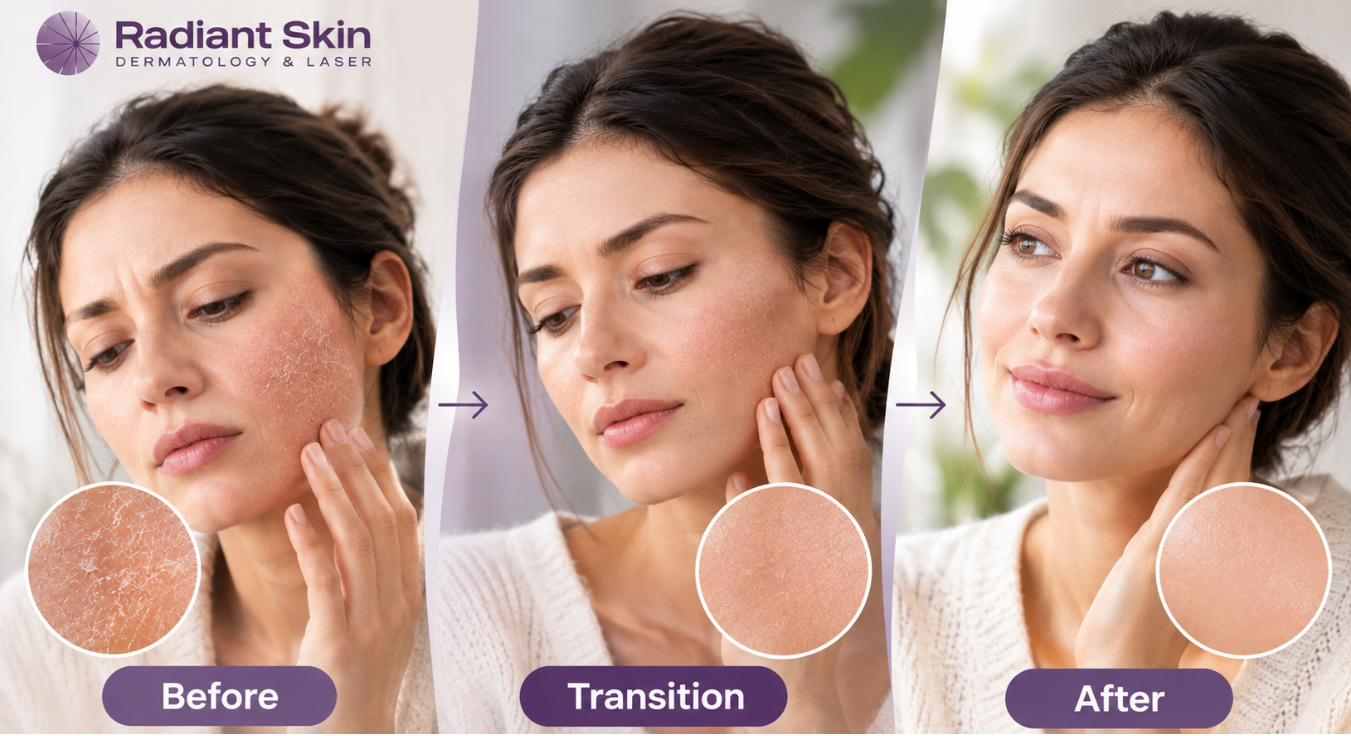
A dermatology appointment is not simply about receiving a stronger moisturizer.
At Radiant Skin NYC, the practice emphasizes working with patients to create personalized, result-driven regimens that support skin health and appearance. The practice is led by Dr. Adebola Dele-Michael, a board-certified dermatologist specializing in general dermatology, dermatologic surgery, and cosmetic dermatology in Manhattan.
That process matters because treatment should be connected to the reason behind the symptoms.
· Environmental dryness
· Atopic dermatitis
· Allergic contact dermatitis
· Another type of eczema
· A different inflammatory skin condition
Radiant Skin NYC's dermatitis guidance notes that determining the type of dermatitis is an important first step, followed by a regimen designed to address flare-ups and help reduce future episodes.
There is no universal definition of “dry skin.” One person's occasional winter dryness can be very different from another person's chronic inflammatorycondition.
Radiant Skin NYC emphasizes personalized regimens designed around individual skin health and appearance.
Dr. Adebola Dele-Michael is board-certified by the American Board of Dermatology and has extensive experience in general, surgical, and cosmetic dermatology. She also serves as an assistant clinical professor of dermatology at the Icahn School of Medicine at Mount Sinai. Her practice highlights individualized care and expertise in treating skin of color.
For someone dealing with severe dryness, that individualized approach can be particularly valuable when symptoms are persistent, recurring, or difficult to explain.
Moisturizer remains an important part of caring for dry skin but it should not become a substitute for understanding what is happening underneath thesurface.
If your skin is repeatedly cracking, itching, scaling, or becoming uncomfortable despite a thoughtful skincare routine, it may be time to stop cycling through products and consider a professional evaluation.
For patients looking for a Severe Dry Skin Doctor NYC, the goal should be more than temporary relief. The right dermatological evaluation can help identify possible causes and create a treatment strategy suited to your individual skin.
Ready to take the next step? Request an appointment with Radiant Skin NYC to discuss persistent or severe dry skin with a dermatology professional.


© Dr. Dele-Michael 2023
All rights reserved.