
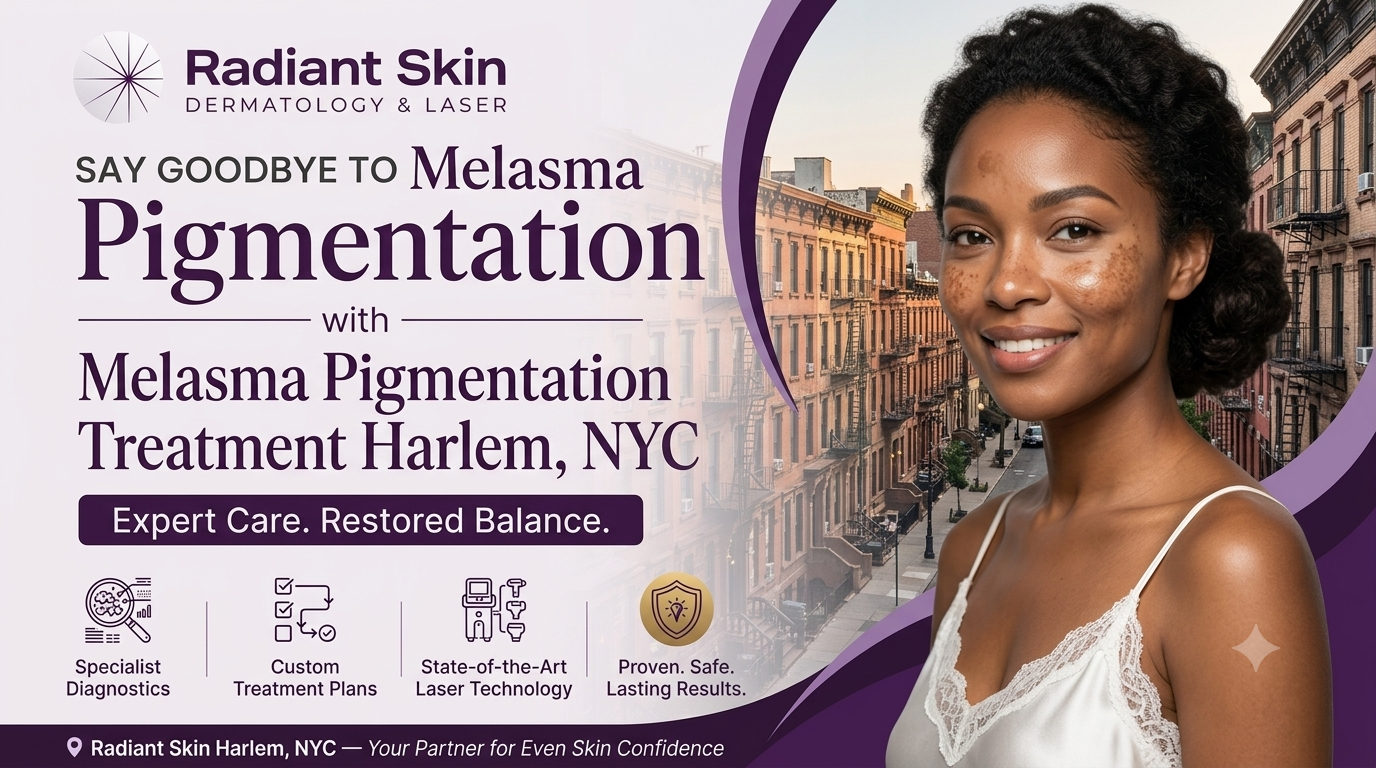
If you are dealing with persistent brown, gray-brown, or uneven patches on your face, you may be experiencing melasma. At Radiant Skin Dermatology and Laser, our Harlem dermatology practice provides personalized melasma and pigmentation treatment designed around your skin type, concerns, and treatment goals.
Melasma can be frustrating because it may improve and then return, particularly with sun exposure and hormonal changes. A dermatologist can help determine whether your discoloration is melasma or another type of pigmentation and recommend an appropriate treatment plan.
Located at 207 W. 115th Street in Harlem, New York, Radiant Skin NYC provides individualized dermatologic care for pigmentation concerns and a wide range of skin conditions.
Melasma is a common pigmentation condition that causes darker patches to develop on areas such as the cheeks, forehead, nose, upper lip, and chin. It occurs when the skin produces excess melanin, the pigment responsible for skin color.
Melasma is generally harmless, but its appearance can be persistent and may affect your confidence. The condition can occur in people of all skin tones and is particularly important to evaluate carefully in patients with melanin-rich or darker skin, where some pigmentation treatments may require additional consideration.
Common factors associated with melasma include:
Because several pigmentation conditions can look similar, an appropriate skin evaluation is an important first step before treatment.
Not every dark patch is melasma. Pigmentation can also result from acne, inflammation, sun damage, medications, or other dermatologic conditions.
For example, post-inflammatory hyperpigmentation (PIH) may appear after acne, irritation, eczema, or another inflammatory skin condition. Sun spots and other forms of hyperpigmentation can have different characteristics and may require different treatments.
At Radiant Skin NYC, your dermatologist can evaluate the appearance and distribution of your pigmentation and consider your medical and skin history before recommending treatment.
There is no single treatment that is appropriate for every person with melasma. Treatment is typically personalized according to the type and severity of pigmentation, skin tone, sensitivity, previous treatments, and lifestyle factors.
Depending on your individual needs, your treatment plan may include professional chemical peels, topical skincare, or other dermatologic procedures.
Radiant Skin NYC offers several professional chemical peel options that may be incorporated into a pigmentation treatment plan.
Available options include:
The appropriate peel depends on your skin and the pigmentation being treated. A dermatologist can determine which formulation and treatment approach is appropriate rather than using a one-size-fits-all procedure.
Long-term melasma management often involves more than an in-office treatment.
Depending on your diagnosis and skin needs, your dermatologist may recommend a customized skincare regimen to help manage pigmentation and support your treatment results. Your plan may include prescription or medical-grade products selected according to your skin's tolerance and treatment goals.
Sun protection is also an important part of managing melasma. Consistent use of broad-spectrum sunscreen and sensible sun-protective habits can help reduce factors that contribute to worsening pigmentation.
Certain pigmentation concerns may be treated with laser or light-based technologies. However, laser treatment is not automatically the best choice for every person with melasma.
In some patients, particularly those prone to pigmentation changes, an overly aggressive procedure may cause irritation or additional discoloration. For this reason, treatment should be selected after a professional evaluation of your skin type and pigmentation.
If a device-based treatment is appropriate for you, your dermatologist can discuss the potential benefits, limitations, and risks before proceeding.
Treating pigmentation in darker skin requires careful consideration.
Patients with deeper skin tones can be more susceptible to post-inflammatory hyperpigmentation after skin irritation or certain procedures. This makes individualized treatment especially important.
At Radiant Skin NYC, we understand that pigmentation treatment should account for your natural skin tone rather than treating every patient with the same protocol.
Our goal is to improve the appearance of unwanted pigmentation while maintaining the health and integrity of your skin.
Your first appointment begins with an evaluation of your skin and concerns.
Your dermatologist may:
This individualized approach helps ensure that treatment is based on your actual skin concerns rather than simply selecting a popular pigmentation procedure.
Radiant Skin Dermatology and Laser is located in Harlem and provides medical and cosmetic dermatologic care under the direction of Dr. Adebola Dele-Michael, a board-certified dermatologist who specializes in general dermatology, dermatologic surgery, and cosmetic dermatology. The practice's website also notes her academic role teaching dermatology residents and medical students.
Our approach focuses on personalized care rather than a one-treatment-fits-all solution.
Patients seeking treatment for pigmentation concerns can receive care based on their individual skin characteristics, medical history, and goals.
Radiant Skin NYC currently provides melasma treatment options including several types of chemical peels and other personalized dermatologic approaches.
Melasma usually requires patience and ongoing management rather than an instant solution. The number of treatments and the amount of time needed to see improvement depend on the severity of the pigmentation, your skin's response to treatment, and the treatment plan recommended by your dermatologist.
It is also important to understand that melasma can recur. Even after pigmentation improves, continued skin care and sun protection may be important for maintaining your results.
Your dermatologist can explain what you can realistically expect based on your individual condition.
There is no single treatment that is best for every person with melasma. Treatment depends on factors including your skin tone, severity of pigmentation, triggers, previous treatments, and skin sensitivity. A dermatologist can determine which combination of professional treatments and skincare is appropriate for you.
Chemical peels may help improve the appearance of pigmentation by exfoliating the outer layers of the skin. Radiant Skin NYC offers several professional peel options, including Radiant Peel, VI Peel, glycolic, mandelic, pyruvic, and salicylic acid peels. The appropriate option should be determined after evaluating your skin.
Melasma can improve with treatment, but it can also return. Sun exposure and hormonal factors may contribute to recurrence, so long-term management is often important.
Yes. People with darker skin can develop melasma and other pigmentation conditions. Treatment should be carefully selected because irritation or inappropriate procedures can sometimes contribute to additional pigmentation.
Sun protection is an important part of managing melasma. Regular broad-spectrum sunscreen use and minimizing excessive sun exposure can help reduce factors that may worsen pigmentation.
Some pigmentation can be managed with an appropriate skincare routine, but persistent or unexplained pigmentation should be evaluated by a dermatologist. Using aggressive bleaching products, exfoliants, or procedures without professional guidance may irritate the skin and potentially worsen discoloration.
Consider seeing a dermatologist when pigmentation is persistent, spreading, recurring, difficult to identify, or not improving with your current skincare routine. A professional evaluation can help determine whether you have melasma, post-inflammatory hyperpigmentation, sun damage, or another skin condition.
If dark patches or uneven pigmentation are affecting your confidence, professional evaluation can help you understand what is causing the discoloration and what treatment options may be appropriate.
Radiant Skin Dermatology and Laser
207 W. 115th Street
New York, NY 10026
Phone: 212-229-0007
Schedule a consultation with Radiant Skin NYC to discuss your melasma and pigmentation concerns and develop a treatment plan tailored to your skin.


© Dr. Dele-Michael 2023
All rights reserved.